Where I am from, education is disregarded by so many. Everyone wants to be successful, drive flashy cars, wear the most expensive clothes and carry the latest phones. But I believe that education is essential for everyone; it is education that helps people to earn respect and recognition.
In my village, which is in Kaduna State in northern Nigeria, hawking is seen as more productive than educating a child. Kids are married off at a very early age, too. You will see a 12 year old who already has a baby and is tied down with so many responsibilities.
In my community, if a parent allows their female child to reach the age of 15 in the house, they are seen as irresponsible and their children will be insulted. At 15, single girl is considered a disappointment because all of her friends are married. No man in the village will want to marry her.
The only girl in school
I was 14 years old when our village school re-opened. Most parents only sent their male children. But my dad had made up his mind to do whatever it took to send his children to school because he had dropped out when he was very young. I was the only girl in the whole school.
With time, my friends started developing interest. Most of them joined because they found it a way to escape chores and others were impressed by the changes they saw in me. Registration was free so anyone could join the school. As for my mum, she only allowed me to go to school because my dad said so. Every morning she gave me stuff to sell when I got to school.
My teacher noticed my interest in studies. He checked my work and corrected me when I was wrong. Anytime he didn’t see me in school, he’d come all the way home and take me on his bike to school because he didn’t want me to lose interest like others did.
By the time I reached my sixth year of primary school, all of my friends had been married off and my relatives kept pressuring my dad to marry me off too. They said: sending me to school was a bad decision because “Educated children end up spoilt and irresponsible”. But he refused.
My dad, school and training have helped make my dreams come true
One day after I completed primary school, my father asked my cousins and my brothers and sisters what plans we had for the future. I was sure that I didn’t want marriage yet so I spoke out. I told him I wanted to continue my studies to university level. He was impressed by my ambitious response and gave his word to support me even though we didn’t have the money.
Three years into secondary school, with no friends but my Dad, bearing long walks to school and back, hardship, hunger, and no money, I almost gave up. But Girl Child Concerns helped me. They helped pay for my school fees and books and gave me life skills training too. My dad and I have decided that any time I come back home for holidays, I will teach my younger relations, married women and other youths who are interested in the things I have learnt at school, including Islamic knowledge.
Many people are impressed by this action I have taken, and wish they chose school over marriage. My sisters say that once they got married, it’s the same routine all the time: chores, babies and all with no money to take care of themselves. The women I teach tell me that they wish they had had the chance to go to school, even for a day.
Others, especially my relatives, are still against it. Whenever I come back for the holidays they look at me in pity and say: “oh maimuna, so this is the path you have chosen for yourself”. Well, “idan ba’a yi sharan masallaci ba ‘a yi na kasuwa” meaning- one day, in the process of getting western knowledge, I will end up with an unwanted pregnancy. Their words hurt me but I refuse to give up.
When I finish my studies I want to improve health in my community
I have chosen to study health. My community has a large population and an unending problem of early marriage, which means children are born every day. But there is only one hospital, with 6 wards and few attendants. It’s more like a pharmacy or clinic because only minor injuries can be treated. For most problems, they just prescribe panadol, drips and injections, without finding out what the patient’s problem is.
Lives are at risk, and that touches my heart. When I finish my studies I will go back to my village and make a change. To help with the reconstruction of the hospital; treat as many people as possible, assist the pregnant, old and helpless. I believe that with good health we can all work to achieve our dreams. This is the goal I have set for myself and by God’s grace nothing will stop me from achieving it.
I would like to use this as an opportunity to advise or plead any parent who is reading this to allow their children, especially girls, to go to school. Those who have been lucky to go to school should please try to share the knowledge they have acquired with siblings, friends, whoever they can reach out to. We should recognise that “the best gift any parent can give to their child is education”.
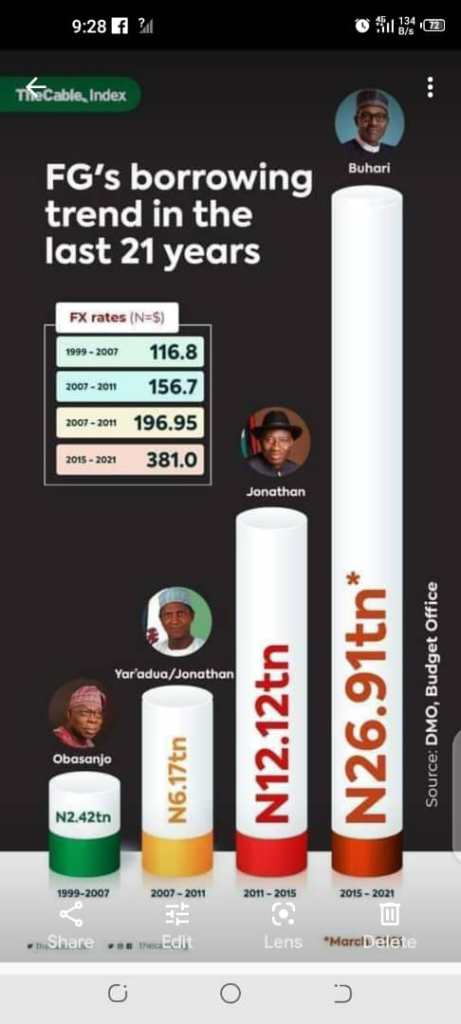
Federal Government borrowing.
Federal Government External loans rise 366% since 2015.
Nigeria’s external loan stock is set to hit an all time high of $45 billion, following President Muhammadu Buhari’s request for fresh external borrowing to the tune of $4.054 billion from the Senate yesterday.
The proposed addition to the debt stock indicates that external borrowings have skyrocketed the nation’s foreign debt portfolio by 366 per cent since 2015 when the total outstanding foreign debt was $9.7 billion.
This comes against a huge decline in actual revenue over a six year period with 2020 recording N3.4 trillion, about 37 per cent decline against N5.43 trillion recorded in 2015.
Also, approval of the new request will bring the total approved foreign borrowings in 2021 alone to $12.3 billion.
The new borrowings are tied to funding projects captured in the 2018-2021 borrowing plan.
Buhari writes Senate for additional $4bn loan
Buhari in the letter dated August 24, 2021 and read during plenary yesterday by President of the Senate, Senator Ahmad Lawan, is asking for external borrowing of $4.054bn, €710m, $125m in addendum to the 2018-2020 borrowing plan.
The letter explained that the projects listed in the 2018-2021 Federal Government Borrowing Plan are to be financed through sovereign loans from the World Bank, French Development Agency, AFD, China Exim-Bank, International Fund for Agricultural Development, IFAD, Credit Suisse Group and Standard Chatered/China Export and Credit (SINOSURE) in the total sum of USD4,054,476,863.00; Euro 710,000,000.00 and Grant Component of USD125,000,000.00.
According to him, the amount will be used to fund federal and states government’s projects across key sectors, such as infrastructure, health, agriculture and food security, energy, education and human capital development and COVID-19 response efforts.
President Buhari explained that the projects which are spread across the six geo-political zones of the country, would bring about employment generation and poverty reduction, as well as protection of the most vulnerable and very poor segments of the Nigerian society.
The letter read: “I write in respect of the above subject and to submit the attached addendum to the proposed 2018-2021 Federal Government External Borrowing (Rolling) Plan for the consideration and concurrent approval of the Senate for same to become effective.
“The Senate President may wish to recall that I earlier transmitted a request on the proposed 2018-2020 Federal Government External Borrowing Plan for the concurrent approval of the Senate in May, 2021.
“However, in view of other emerging needs and to ensure that all critical projects approved by FEC as at June 2021 are incorporated, I hereby forward and addendum to the proposed Borrowing Plan.
“The Projects listed in the addendum to the 2018-2021 Federal Government External Borrowing Plan are to be financed through sovereign loans from the World Bank, French Development Agency (AFD), China-Exim Bank, International Fund for Agricultural Development (IFAD), Credit Suisse Group and Standard Chatered/China Export and Credit (SINOSURE) in the total sum of USD4,054,476,863.00; Euro 710,000,000.00 and Grant Component of USD125,000,000.00.
“The Senate is kindly invited to note that the projects and programmes in the Borrowing Plan were selected based on positive, technical and economic evaluations and the contribution they would make to the socio-economic development of the country including employment generation and poverty reduction as well as protection of the most vulnerable and very poor segments of the Nigerian society.
“The Senate may also wish to note that all the listed projects in the addendum form part of the 2018-2021 External Borrowing Plan and cover both the Federal and States Government projects and are geared towards the realization of the Nigeria Economic Sustainability Plan that cut across key sectors such as Infrastructure, Health, Agriculture and Food Security, Energy, Education and Human Capital Development and COVID-19 Response efforts.
“A summary of some key projects in each of the six geo-political zones and a summary on the expected impacts on the socio-economic development of each of the six (6) geo-political zones are attached herewith as Annex II and III.
“Given the importance attached to the timely delivery of the projects listed in the proposed Borrowing Plan and the benefits both the Federal and State Governments stand to gain from the implementation of same, I hereby wish to request for the kind consideration and concurrent approval of the Senate for projects listed in the addendum to the 2018-2021 Federal Government External Borrowing Plan to enable the projects become effective.”
Historic debt level
The nation’s external debt stock could hit over $36 billion, if the National Assembly approves the $4.054 billion new borrowing request presented by the executive to the federal legislators, yesterday.
President Obasanjo launched a relentless debt relief campaign for Nigeria when in 2004 the nation’s debt external stood at $36 billion, with the country spending more on interest payments than on health care and education, put together. This debt relief effort yielded fruits on June 29, 2005, when the Paris Club and Nigeria agreed on an US$18 billion debt relief package, with the country paying off the balance to free the nation.
Official figures of the Debt Management Office, DMO, put the external debt stock at $32.859 billion, as at March 31, this year.
Since then, the National Assembly has approved an $8.325 billion new borrowing plan for the President Muhammdu Buhari, administration to enable it implement the 2021 budget.
That approval followed consideration of a report on the 2018-2020 External Borrowing (Rolling) Plan by the Committee on Local and Foreign Debt.
Chairman of the Committee, Senator Clifford Ordia, had explained that the borrowing was imperative due to the shortfall in the country’s annual revenues in relation to the need for rapid infrastructural and human capital development, adding, “we have had to pass deficit budget every year, requiring us to borrow to finance the deficit in our budget.”
However, the administration has yet to borrow the entire figure, as approved, as officials of the Federal Ministry of Finance, Budget and National Planning are said to be weighing options available to the nation, in order to get the best deal, with concessionary facilities being considered as their preference.
It was learnt that the 2018-2020 External Borrowing Plan contained $36.837 billion.
However, only about $7 billion was approved by the Sen. Bukola Saraki-led Senate of the 8th Senate, in the first instance.
Consequently, the executive was said to have continued to re-present the request to the Senate.
For instance, the July approval was obtained after the president re-presented the request for $26.154 billion.
Debt servicing capacity critical— Muda Yusuf
For most analysts while the reason for the borrowing spree has become worrisome due to weakening capacity to service the debts.
Dr Muda Yusuf, economist and former director-general of the Lagos Chamber of Commerce and Industry, LCCI, said: “The growing stock of debt is a cause for concern. Current levels of debt are already at an unsustainable threshold. If over 80 per cent of revenue is used to service debt, then it is about time to slow down on debt accumulation.
READ ALSO: 2018-2021 plan: Buhari seeks Senate approval for additional external loans “From reports, this request is new as it was not covered in the original borrowing. It is an addendum to the original plan which had already been approved.
“Of course there is merit in borrowing for infrastructure development, but even at that, the capacity to service the debt sustainably should be a critical consideration. The risk is that at this rate, part of the borrowing will inevitably be used to fund recurrent expenditure. Already, actual revenue can hardly cover recurrent budget. The risk of ending up in a debt trap is quite high.”
Also commenting, Ayodeji Ebo, Head, Retail Investment, Chapel Hill Denham, a Lagos-based investment house, said the rate of accumulation of loans by the federal government is becoming unsustainable due to low productivity.
He said: “For transparency, these borrowings should be attached to projects like the Sukuk bond offer. The rate of accumulation of loans is becoming unsustainable due to low productivity. With debt servicing as a proportion of actual revenue almost hitting 100 percent, it calls for serious concern. The exchange rate risk that balloons our borrowings in naira value will also be amplified with continued external borrowings.”
FG should leverage capital market —Oni
Reacting as well, Chartered Stockbroker and Chief Executive of Sofunix Investment & Communications, Mr Sola Oni said: “At present, over 90 per cent of Nigeria’s revenue goes for debt servicing and the bulk of the debt is appropriated for recurring expenditure. Rather than plunge Nigeria into bankruptcy due to debt albatross, the Federal Government should leverage the capital market to access long-term funds to finance capital expenditure.
“This option has a strong prospect to accelerate economic growth and development by creating enabling environment for businesses to spring up with multiplier effects on employment and increased total output. There are other creative means to raise funds such as selling of moribund government assets to the private sector operators.”
PDP rejects fresh borrowings
Meanwhile, Peoples Democratic Party, PDP, also rejected moves by the President Muhammadu Buhari for another external loan.
On a statement signed by the spokesman, Kola Ologbondiyan, the party lamented that with the N33.107 trillion debt already accumulated by President Buhari and the APC “with nothing to show but decayed infrastructure and a depressed economy, an addition N5.62 trillion borrowing proposed by Buhari for the 2022 budget and now a fresh N2.66 trillion external loan, the APC will be hanging over N40 trillion debt on the nation, with no clear-cut repayment plan.”
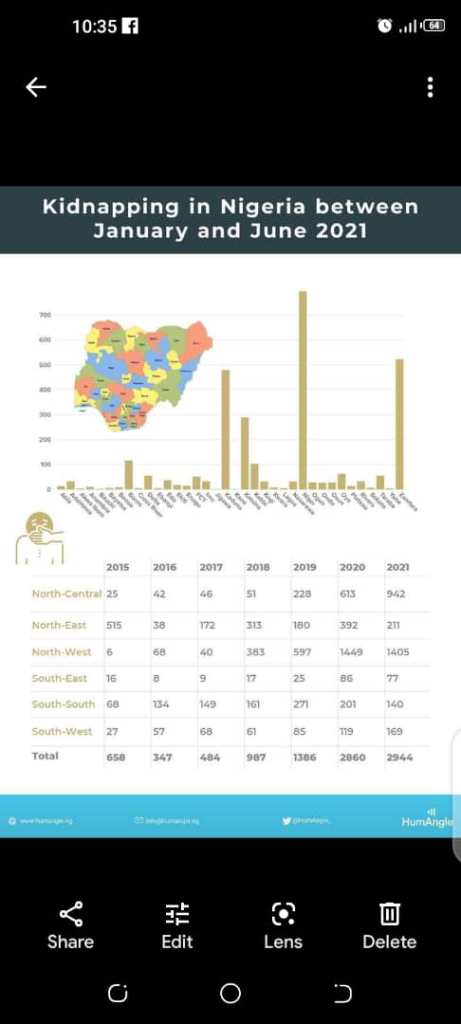
Since April 2014 after the Boko Haram terrorists abducted 276 schoolgirls from their dormitories in Chibok, Borno State, mass kidnapping for ransom has gradually, become the other of the day in Nigeria. by Sunday Vanguard show that the country has witnessed staggering 111 kidnapping incidents in the last eight months, that is, from January to mid-August, 2021. The total figure represents confirmed cases by the police and eye witnesses’ accounts eventually reported by the media. Sunday Vanguard learned that many other unreported incidents may have taken place, especially in Niger, Zamfara, Sokoto, and Katsina states (North-West and North-Central) where banditry is raging. Thus, the sum total may well be above 111 if all cases were captured. The highest number of kidnap cases (27), was recorded in February with 605 victims. This was closely followed by July (23) and January (21) with 327 and 284 victims respectively. The situation was made worse due to alleged breakdown of security architecture in the country especially in the North-West and North-East. Security experts say the inability of the Federal Government, through the security agencies, to stem the development has led to a surge in kidnapping and banditry. According to the experts, armed bandits have taken advantage of weak security presence to continue their reign of terror on schools, villages and highways. SBM Intelligence According to a report by SBM Intelligence, an average of 13 persons were abducted daily in Nigeria in the first half of 2021, thereby underscoring how common and daring the criminals have become. The findings, which covered Nigeria’s six geopolitical zones, South-West, South -East, South-South, North-Central, North-East and North-West, and the Federal Capital Territory, FCT, Abuja, represent the reported cases. The pattern of abduction remained the same in the North, where victims were often kidnapped en mass during attacks on remote villages and schools. Mass abduction of travellers on highways emerged as the latest mode of operation by gunmen who have become more daring. This is not prevalent in the North alone as highways in the South-West and South-South have become hot spots of the dangerous roads identified include Benin-Ore Highway, Benin-Auchi-Okene Highway, Keffi-Akwanga Highway, Akure-Owo Expressway, Abuja-Abaji-Lokoja Road, Zaria-Sokoto-Gusau,Bauchi-Tafawa-Balewa Highway, Wukari-Takum Road and Minna -Kotongora Road. In the South-West where herdsmen have been accused of most of the incidents, victims were often abducted on highways and farms. Clear strategy Sunday Vanguard notes that after each mass abduction, state and federal governments condemn the attack in strong terms, with promises to rescue abductees. Without any clear strategy for arresting the scourge, which has spread to every part of the country, authorities and individuals pay huge sums to kidnappers. Kidnapping: Fast growing industry Sunday Vanguard investigations also showed that about N11.415 billion was demanded as ransom for kidnapped victims across the country. Kidnapping has become commonplace and a sort of business to bandits and other criminal elements who raid, kill and mass kidnap for ransom, particularly of school children. It is a fast growing industry and has remained the most virulent form of banditry in the country. Recent reports have shown that criminals are often driven by financial motives to kidnap children and others and hold them for ransom. Attacks on schools Nigeria’s kidnap-for-ransom industry is growing, and it’s not just the well-off who are at risk. The new targets are poor villagers and ordinary schoolchildren. Since the well-publicised abduction in 2014 of 276 schoolgirls from Chibok by Boko Haram terrorists in Borno State, more armed groups have resorted to mass abduction of students. Authorities say recent attacks on schools, especially in the North-West, have been carried out by bandits, who are largely motivated by money. The timeline below shows how thriving kidnapping has become in Nigerians August 3, 2021: Police kill three kidnappers, rescue commissioner’s wife and driver in Benue August 5, 2021: Bandits kidnap father of Zamfara Assembly Speaker, five others August 9, 2021: Gunmen kidnap Niger Commissioner for Information August 9, 2021: Pastor, wife, 27 others kidnapped in Kwara August 12, 2021: Gunmen abduct ex-councillor’s wife, 7-month-old son in ZamfarJuly 3, 2021: Bandits abduct 7 women, 4 children along Birnin Gwari Road July 5, 2021: Boko Haram abducts Rev. Fr. Elijah Juma Wada of Catholic Diocese of Maiduguri. July 5, 2021: Gunmen attack National Leprosy and Tuberculosis Centre in Kaduna, kidnap 8 July 5, 2021: 150 students abducted from Kaduna school July 6, 2021: Gunmen kidnap 4 farmers in Ekiti July 8, 2021: 16 kidnapped by gunmen in Damishi, Kaduna State July 8, 2021: Bandits demand N220 million as ransom for 11 persons abducted from Anguwan Gimbiya, a suburb of Kaduna State July 11, 2021: Emir of Kajuru, 13 family members, aides, kidnapped in Kaduna July 13, 2021: Kogi monarch kidnapped July 14, 2021: Wife of former LGA Chairman kidnapped in Jigawa July 16, 2021: Former Provost Marshal of the Nigerian Army, Maj. Gen. Hussaini Ahmed, killed, in-law kidnapped by bandits along Lokoja-Abuja highway. July 18, 2021: Bandits kill one, abduct 7 in attack in Kaduna July 18, 2021: Bandits attack two vehicles, abduct six occupants around Bade forest in Kaduna July 19, 2021: Gunmen kidnap medical doctor in Kogi July 19, 2021: Five kidnap suspects set ablaze in Edo July 19, 2021: Gunmen hijack boat, abduct 5 maritime union workers, 3 others in Rivers July 19, 2021: Armed herders abduct, kill 2 aid workers, Gov Ortom’s relation, 5 others in Benue July 21, 2021: Kidnappers abduct 38-year-old man in Jigawa July 21, 2021: Bayelsa SSG’s mother kidnapped July 25, 2021: Gunmen hijack 3 buses, kill 2, abduct 60 passengers in Sokoto July 26, 2021: Bandits abduct monarch in Kaduna, demand N100m ransom July 30, 2021: Unknown gunmen kidnap night club operator in Bayelsa June 2, 2021: 200 pupils of the Salihu Tanko Islamiyya School in Tegina, Niger State abducted. June 4, 2021: Bandits kidnap 2 Kaduna nurses
June 8, 2021: Kidnappers abduct Abuja tailor, Mary Adi June 9, 2021: Abductors kidnap Dr Dan Ella, a lecturer in the Department of Theatre Arts, University of Jos. June 14, 2021: Ekiti farmer, Jimoh Olodan, kidnapped June 17, 2021: Armed bandits strike, abduct students at Federal Government College, Birnin Yauri, Kebbi State. June 28, 2021: Ekiti monarch, Oba Benjamin Oso, kidnapped June 28, 2021: One Lukman Ibrahim kidnapped, pregnant wife killed in Offa, Kwara State June 30, 2021: Bandits kidnap students of Bethel Baptist School, Kaduna; and Peter Jediel, the Chairman of the Nigeria Labour Congress in Taraba State May 2, 2021: Kogi council chairman abducted May 12, 2021: Ondo graduate abducted May 16, 2021: Ondo pastor, Otamayomi Ogedengbe kidnapped READ ALSO: IGP visits Awolowos, say kidnapping cases over-rated May 29, 2021: Katsina Sharia Court Judge, Alkali Hussaini Sama’ila, kidnapped May 30, 2021: Armed gang abducts over 100 students from an Islamic school in Niger State May 30, 2021: Nasarawa State House of Assembly member, Ismail Danbaba, abducted in Kaduna April 6, 2021: Kidnappers kill Lagos-based pastor in Ondo after collecting N2m ransom April 7, 2021: Kidnappers abduct 2 Chinese miners in Osun State April 19, 2021: Masked armed men kidnap 2 Fulani in Oke-Ogun, Oyo State April 20, 2021: Gunmen kidnap 20 students, 2 staff members of Greenfield University, Kaduna April 23, 2021: Ekiti traditional ruler, Oba David Oyewumi, abducted April 26, 2021: Three kidnapped construction workers in Ondo released April 27, 2021: Nursing mother, 8 others in Ogbomoso, Oyo State abducted March 8, 2021: Bandits kidnap 30 in Rafi LGA of Niger State March 11, 2021: Gunmen kidnapped 39 College of Forestry, Afaka, Kaduna March 23, 2021: Gunmen kidnap FCTA staff members, 3 others March 28, 2021: Abductors of RCCG members in Kaduna demand N50m ransom March 29, 2021: Kidnappers of Sarkin Hausa younger brother in Osun demand N50 million ransom February 1: Kaduna State Commissioner for Internal Security and Home Affairs, Samuel Arwan, says some people abducted when bandits attacked Barawa village, Fatika District, in Giwa LGA of the state. February 1: Peace Ogbogbo, wife of an Ughelli businessman in Ughelli North LGA, Delta State, kidnapped February 2: The police in Abuja confirm abduction of John Makama, father of Gwari Local Council Chairman February 2: 40 people kidnapped in a renewed bandit attack on Shiroro communities in Niger State February 6: A farmer, Solomon Akinmeji in Iju Akure North Council Area of Ondo State, kidnapped February 9: Gunmen attack ambulance conveying a corpse, killing an occupant and abducting one at Ahor, Benin Bye-pass, Edo State
February 9: Jimoh Folowosele, an indigene of Aramoko Ekiti, in Ekiti West LGA, abducted while on official duty in Geidam, a border town in Yobe State
February 9: A 46-year-old tipper lorry owner in Ilorin, Alhaji Musa Atere, kidnapped along Ogundele/Madi Road in Ilorin LGA of Kwara State.


 Site Title